

Murky. Opaque. Vague. Pick your preferred term to describe the inflation picture. Many have myopically focused on the Middle East conflict as the reason for sticky inflation. However, inflation crosswinds have created a turbulent environment.
Clearly, the biggest energy impact is the Iran conflict. The conflict has fluctuated between hostility and calm. The “peace deal” at the end of the second quarter was short-lived, with gas and diesel prices returning to higher levels. More broadly, diesel has a wider economic impact as diesel powers logistics and shipping, fundamentally raising goods and services prices.
The U.S. and Venezuela reached an agreement that gives the U.S. a 35% equity stake in a company that now has 100-year concessions to 65 billion barrels of proven oil reserves. Put simply, the U.S. gets extensive governance rights and guaranteed access to at least 20% of production at cost. Additional supply would contribute to lessened inflation pressure.
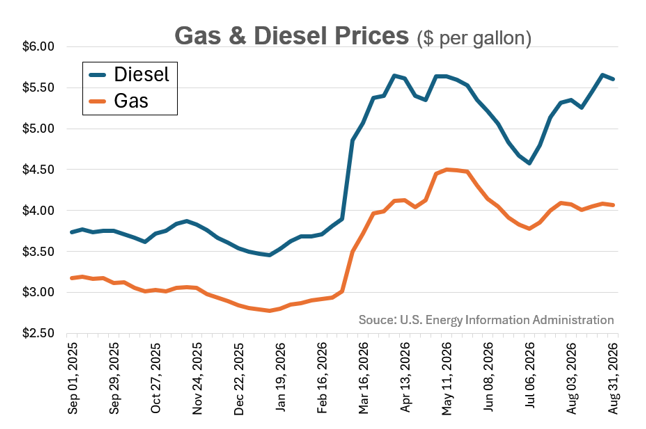
Autumn is generally accompanied by lower gas prices. Winter gas blends tend to range between 10 and 30 cents cheaper than the higher summer blends. Winter blends have a higher concentration of low-cost butane as opposed to summer’s more costly alkylate and reformate. Additionally, colder winter months come with less travel, which translates to lower gas demand. Such elements ease inflation pressure.
Recent food inflation has been fairly benign, generally trending below 3%. However, that may change. Minimal snowpacks over the past few years have resulted in low Colorado River yields. The consequence is western reservoirs, specifically Lake Powell and Lake Mead, seeing lows that rival their original construction levels. In fact, the U.S. government recently placed a mandatory 40% water restriction on western states. What’s the impact nationally? The majority of winter fruits, vegetables, and nuts are grown in the Central Valley. Lower water consumption stunts food supply, which contributes to higher food prices.
The Employment Cost Index (ECI) has been consistently falling for several years, currently just above 3%. Should such trends continue, employers’ lower costs could be passed along to consumers.
As AI, automation, and mobility become more entrenched in our lives, so do the efficiencies that follow them. Admittedly, technological implementation is more impactful long-term. However, it seems we are on the precipice of big strides towards taking advantage of such efficiencies.
We can go on, but you get the point. Inflation, which is an economic fundamental, is in a dicey spot for the near-term. Even the Federal Reserve, which sets U.S. interest rate policy and is followed by other central banks, is unsure of the inflation road ahead. How these various inflation pressures play out over the next few months and quarters could be instrumental in interest rate policy and economic direction.
Recent Comments