

Last week’s labor market data effectively locked in an interest rate cut for the September 17th Federal Reserve (Fed) meeting. In fact, markets are no longer factoring in just 0.25% but entertaining a possible 0.50% cut. We feel 0.50% for an opening salvo at this point is too aggressive.
Last week’s labor market data gave economic nerds a lot to banter about. News articles and TV shows were quick to offer pundits facetime.
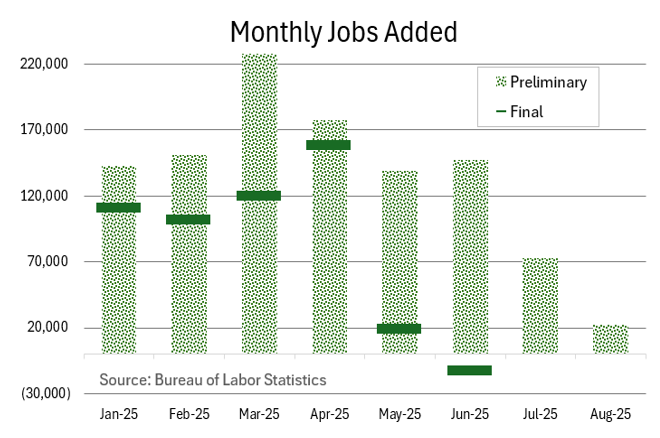
There was plenty of ammunition to support whatever view you prefer. The short of it is that labor markets are softening.
Gurus are debating, “Is the labor market softening, suggesting an imminent recession, or is this akin to a plane’s pause before barreling down the runway to take off?” This is a very good question that only time will tell. Commentators could be missing another possibility: a pause for companies to assess the economic environment. Generally, companies control costs by reacting to circumstances, not the other way around. The historical tariff record is clear; it’s a toss-up whether positive or negative effects will follow. So, companies are likely playing it safe, not adding to their costs until they have a better grasp of the economic environment.
Talking heads are often given limited airtime or truncated quotes, restricting their message. They seem to be focused on job growth falling short of expectations. Our newsletters try to offer a more complete picture. What many talking heads are missing is the lack of layoffs/quits. In other words, recent labor markets are best described as low-hiring AND low-layoffs/quits. This supports our view that this is more of a pause to evaluate the environment as opposed to an imminent recession or a pause prior to takeoff.
To further build out our view, there are other ignored labor market reports. Labor productivity was noticeably revised higher, and labor costs were markedly reduced. So, to recap… 1) low hiring, 2) low layoffs/quits, 3) lower labor costs, and 4) high productivity. All this points to what we suggested last week, higher implementation of non-human labor via automation, kiosks, apps, AI, and robotics.
Japan has the world’s oldest population, with about two workers supporting one retiree. Europe, America, and other Asian countries need to look no further than Japan’s use of automation, kiosks, and apps to see increased efficiency and productivity with a smaller labor pool. In many cases, restaurants, hotels, etc., require little to no human interaction. Factories have been using single-task robotics for decades. These single-task robots are being replaced with multi-task robots with manipulative digits and evaluative AI software. To see where we are going, look no further than Japan. Welcome to the new world.
Recent Comments