

Another week, another surprise. After a four-week decline, equity markets started this week with a bang. What was the catalyst? President Trump’s calls for a pause in Iranian strikes in pursuit of productive talks.
Such dramatic ebb and flow can cause angst, prompting investors to consider “safer ground” until the dust clears. Unfortunately, that may be too late.
Counterintuitive as it may seem,
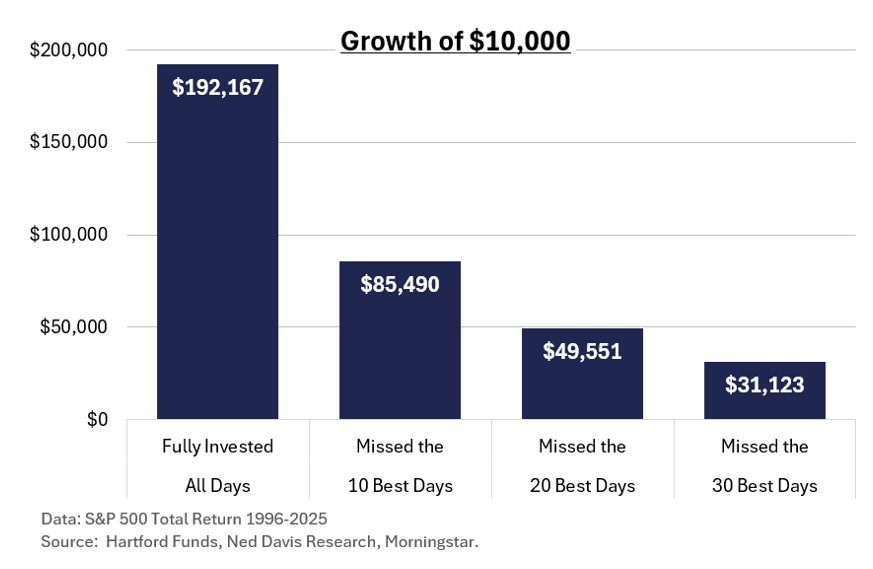
the best-performing days tend to be clustered with some of the worst days. Dramatic downward movements tend to be a result of unexpected news, data, or events. Trading, a human decision-making activity, tends to overreact as selling pressure drives stocks down. Once cooler minds prevail, and the frontal lobe is reengaged, stock prices often jump northward.
Every investor is confronted with the scariness of falling stock prices, which appears as hard-earned savings disappearing. This is when near-term fear can alter your long-term goals. Missing out on just a few big days can make a significant difference in your long-term return. As the chart below shows, a hypothetical investor who missed just the best 5 days in the market since 1996 could have detrimentally reduced their long-term gains.
Understanding the relative effects that recessions, volatility, bear markets, and investor behavior have had on portfolios is a key component to making more informed decisions about when and how to invest. However, even this knowledge may not be enough to assuage investor anxiety when the market declines and portfolios suffer. Thankfully, there are methods available to help investors avoid reactive decision-making.
- Match investment horizon with appropriate asset risk levels.
- Short-term cash needs, cash needed for expenses in the next 2-3 years, should be invested in cash, cash equivalents, and short-term bonds, not in stocks.
- Make sure you have an emergency fund for unexpected happenings.
- Equity investments should be used for long-term objectives to ride out the near-term volatility that accompanies stock investments.
- Establish a well-diversified portfolio with different types of securities, asset classes, and vehicles.
- Be careful to fully commit all your assets to the most recent investment fad or sector. As tempting as it is, fads change, as does the direction of investment dollars.
After a four-week decline in the equity markets, investors may be tempted to abandon their portfolios and move to cash. This often leads to missing the upside when it appears, which often shows in dramatic fashion. The current financial markets are not trending on underlying fundamentals; they are trading on Middle East news. One needs to look no further than President Trump’s remarks Monday morning, which immediately resulted in a surge of stock prices.
Recent Comments