
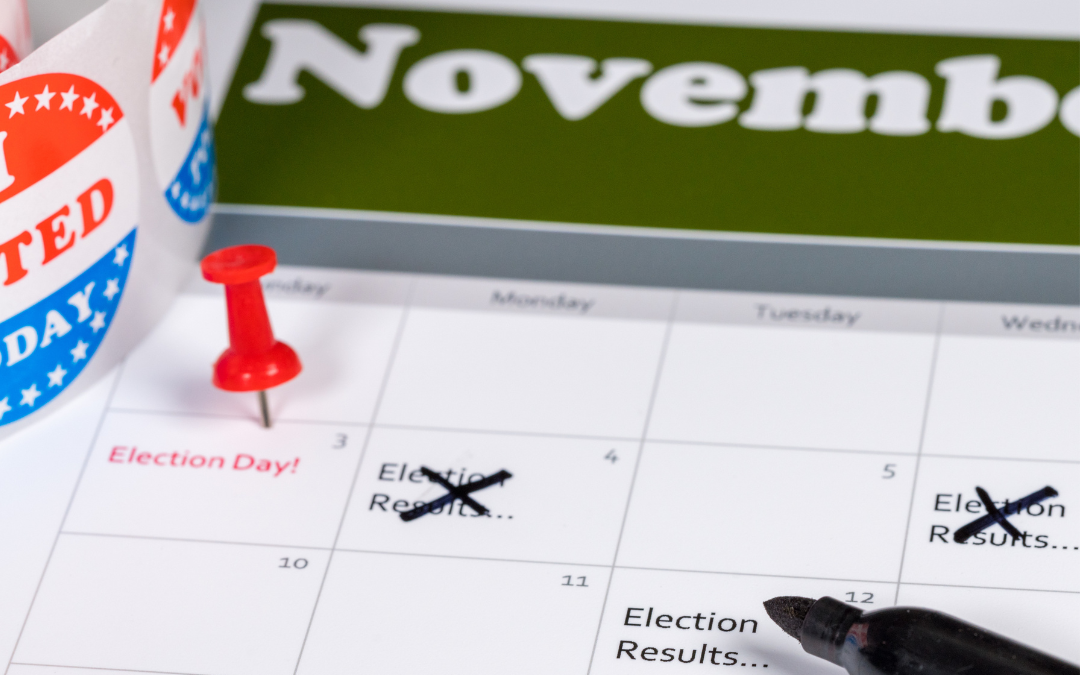
In June, we wrote about how stocks historically behaved during midterm election years, and last month we looked at whether the makeup of Congress has actually mattered for returns. That leaves the next question you might ask once the yard signs go up: what happens after election day?
Going back to 1942, there have been 21 midterm elections. Measured from election day to June 30 of the following year, the S&P 500 has been higher every single time. Not most of the time. Every time. The median gain is 17.0%, and the weakest result was a 2.5% rise after 2014. That streak spans World War II, Vietnam, the 1970s, the dot-com bust, and the Great Financial Crisis.
The explanation is probably not that elections are good for stocks, but that resolution is. A midterm converts a wide range of possible policy outcomes into a single known one, and the result matters less than the fact that there is a result. The market has historically started climbing about a month before election day, while the outcome was still truly in doubt. Uncertainty does not have to disappear for stocks to move. It only has to shrink.

That history is usually quoted without its second half. Midterm years have been the roughest stretch of the four-year presidential cycle, and no year carries a larger peak-to-trough decline, averaging 17.5%. The gains above were earned climbing out of that hole. This year we have barely dug one. The deepest decline has been half of that at 9.1%, when the conflict with Iran took the wind out of the market in the first quarter. The S&P 500 closed at an all-time high on August 7, about 13% above where it started the year. We are not looking up at this pattern from a trough. We are looking at it from a high. Plenty could still change that: a Fed still split on whether to hike, energy prices feeding into core inflation, and July payrolls that showed outright job losses.
So, what do we do with twenty-one for twenty-one? Not much, if the instinct is to trade it. The record does not justify adding risk in anticipation of a post-election rally. What it justifies is patience. The common mistake in the months before an election is cutting exposure because the headlines feel ominous, then waiting for clarity that tends to arrive only after the market has already moved.
Between now and November 3, the volume only rises. Campaign ads, polling, predictions, and a steady supply of reasons to believe this election is the one that finally breaks something. By next summer, it will all be in the distant rearview for the market.
The work between now and November is unglamorous: Do nothing, and resist building a position around a political forecast. The market has a way of climbing on the other side of November regardless of which side wins.
Recent Comments