

The August 1st trade deadline has [kind of] come and gone. Some countries wasted no time in striking a deal with the Trump administration, while others received an extension, leaving the remaining countries without trade deals. A quick review of what’s outstanding may reveal some surprising results. We will continue to monitor the negotiations and trade deals.
As of July 31st, one of the United States’ major trading regions, the European Union, struck a deal with the US negotiators. As with most
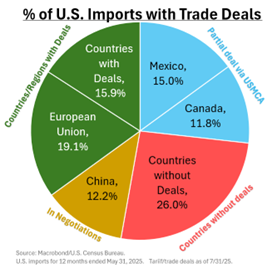
negotiations, there are pros and cons to each side. The main highlights include a 15% ceiling on most transatlantic EU exports, large EU purchases of American energy and military purchases, and large EU Foreign Direct Investment in the US1. Overall, the US received much of what they sought while the EU retained what they wanted, access to American consumers. Other countries with trade deals include Japan, Vietnam, the Philippines, South Korea, and the U.K. In sum, 35% of US imports are accounted for by a recent trade deal.
Given the recent tariff talk, it’s easy to forget that Mexico and Canada already have a trade deal in place. The U.S.-Mexico-Canada Agreement (USMCA) took effect in 2020. For historical reference, USMCA replaced the North American Free Trade Agreement (NAFTA), which took effect 16 years prior. The USMCA does not cover all US imports, but it covers a significant portion of trade between the three countries. Much of the threatened tariffs are on goods not covered under USMCA. For argument’s sake, we’ll say Mexico and Canada have a “partial” trade deal.
Mexico and China were granted a 90-day extension in light of ongoing good-faith negotiations. Canada, on the other hand, has dug their heels in the sand. Our concern is that Canada may have overestimated their hand. Unlike the US, with a wide array of trading partners, approximately 77% of Canadian exports arrive on US soil2. Hence, Canada has a single primary customer, giving that customer, the US, pricing power.
Secondly, Canada is battling a serious secession movement spearheaded by Alberta. Alberta produces the vast majority of Canadian energy, which also accounts for a very large portion of exports to the US. Ottawa, Canada’s capital, may need to make concessions to Alberta to retain the province and the commensurate energy exports. Should Alberta secede, Alberta takes their energy exports with them, weakening Canada’s tariff/trade bargaining power. To add salt to the wound, Saskatchewan, Canada’s breadbasket with its vast prairies, seems to be aligning itself with Alberta, further complicating Ottawa’s math. Secession is not a near-term concern, but something to watch over the next 24 months, and complicates current negotiations.
So far, higher tariffs haven’t shown signs of being a major problem for the economy. Measures of consumer and business confidence have rebounded, which is encouraging for economic activity. We will be watching the incoming data closely to see whether this resilience continues or if inflation ticks up and cracks in the economy start to emerge.
Recent Comments