

The old expression “the bond market is supposed to be quiet, and it is a big deal when it is not” comes to mind given recent bond market headlines. Yields on the 10-year Treasury bond reached 4.72% this past Monday, levels not seen since 2007, except for a period in 2023.
Interest rates had been in a secular decline since the early 1980s. Yields bottomed below 1% in 2020, with yields shooting up since. Such a pattern is not a U.S. phenomenon, but a global one. The chart shows economically important 10-year yields from major economies. Longer- and shorter-dated yields replicate a similar pattern. The point is recent bond headlines have focused on the U.S. when it’s an international reality.
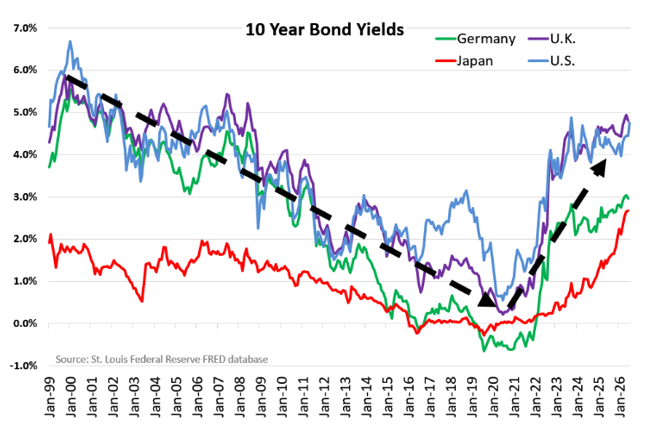
The 40-year secular yield decline resulted from a number of economic forces as well as Federal Reserve (Fed) Chairman Volker’s temperament to battle the late-70s inflation. Fed chairpersons following Volker pursued Kolker’s mandate, ultimately driving yields to bottom-of-the-barrel lows. The upturn since 2020 was a direct result of COVID outlays and helicopter cash that rained down. Higher rates were inevitable.
Considering the historic backdrop, where are we today? The bond market is known as the pessimist of the financial markets. Bond participants are more concerned about getting their money back, which differs from stock investors looking to profit from the next trend.
Bond investors should have little to worry about. The macroeconomic picture is on solid footing. Consumer consumption has been resilient. Business investment has accelerated. The Unemployment Rate is stable, with recent jobs data showing job increases. Even the Iran-induced inflation uptick has escaped dire predictions. It is hard to find evidence that the sky is falling.
Nothing is ever perfect. Last week’s comments from Treasury Secretary Bessent sent shivers through the bond market. If everything looks good, why is the Treasury modifying its approach? Good question. Such a juxtaposition jolted bond yields. The media incorrectly linked the yield instability with the national debt crossing $40 trillion. Our take is… since the Fed is hesitant to lower interest rates, as sought by President Trump, Bessent may be attempting to influence bond yields via Treasury action. The U.S. Treasury attempting to sway interest rates is known as a yield curve “twist.” Twists never work in the end.
With attention on the bond markets, it’s a good time to review the virtues of bonds. First, given current yields, bonds can provide practical income not seen for nearly two decades. Second, bonds provide diversification to stock market volatility. This is even more true as the main shock absorber, a bond’s yield, has returned to meaningful levels. Putting recent bond market noise aside, current bond market positioning points to accretive positioning going forward.
Recent Comments