

The U.S. economy continued to expand, supported by resilient consumers, stable labor markets, and steady business activity. While economic production is still growing, sticky inflation, geopolitical wrangling, and interest rate speculation have plagued consumer confidence, leading to financial market volatility.
Economic growth remains positive, with both manufacturing and services sectors contributing to a solid economic expansion. Foreign economies have echoed many of the positive trends. Long-term trends such as reshoring/near-shoring manufacturing, eCommerce, and AI/technology development and implementation have been accelerated by 2026’s tax incentives and consumer spending. Many countries have had the added “bonus” of renegotiated alignments. Specifically, Japan and Europe have taken a more prominent role in their own defense and energy production, sparking their domestic defense and energy industries.
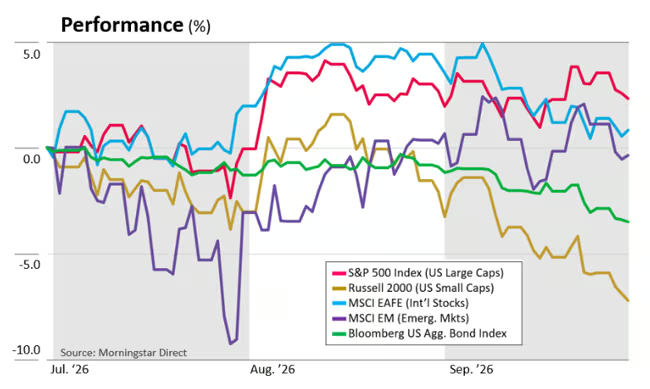
The tailwinds established at the beginning of the year have been confronted by headwinds via energy-induced inflation concerns. Energy’s foundational layer threatens broader inflation concerns. Inflation concerns remain a theoretical construct as actual higher energy effects mostly remain at bay. See the inflation summary below.
Mid-quarter optimism shifted towards pessimism. The Fear & Greed Index moved from high greed levels to low fear levels. Mid-quarter Middle East kinetic positioning was compounded by Federal Reserve (Fed) rate hike speculation and inflation worries. The Fed capitulated to the financial markets’ urging, delivering the first rate hike in more than three years.
At the beginning of 2026, the overwhelming Wall Street consensus was that interest rates would decline throughout the year. Instead, the Fed officially raised rates in September. Though forecasts do not guarantee outcomes, the speculation and public debate gave way to market volatility.
INFLATION
The Federal Reserve cited sticky inflation as a reason for its rate hike in September. The rate hike did not come without controversy. Many investment professionals criticized the Fed’s move as premature, stating inflation was not widespread, but narrow, targeting certain components such as energy, energy-heavy industries, and rent. Once these items are discounted, broader inflation is much closer to the Fed’s 2% target than many realize. Investment professionals questioned the value of hiking rates to decelerate the economy as a path to fight narrow supply-driven elements.

Criticism aside, inflation has remained sticky mainly due to geopolitical entanglements. Concern rests with energy’s ultimate impact. Energy is the most fundamental aspect of all economic activity; goods manufacturing, logistics, and services. Businesses may be able to absorb higher energy prices for a short period of time, but consumers will see higher prices should energy prices remain too high for too long.
EQUITY MARKETS
The stock market moved through the third quarter supported by an encouraging earnings backdrop, while investors remained attentive to inflation, interest rates, and the durability of AI-related investment. Despite the positive economic growth, earnings announcements, and capital investments, the moderate pace of appreciation was interrupted by speculation of the Federal Reserve’s interest rate direction and the on-again, off-again Iran conflict.
Of the 11 sectors, energy and technology were the only two sectors with strong double-digit returns for the third quarter. Energy companies were able to capitalize on higher energy prices while AI interest continues to power technology’s advancement. Most sectors ended up giving back gains from previous quarters.
FIXED INCOME MARKETS
The bond market faced headwinds during the third quarter as investors balanced persistent inflation against a more restrictive Federal Reserve policy outlook. Elevated energy prices and advancing yields took their toll on bond prices in the third quarter. Bonds, holding their own through the second quarter, succumbed to Federal Reserve rate hike speculation, pushing year-to-date returns into negative territory.
After the first Fed rate hike since July 2023, the Fed’s post-meeting remarks suggested future rate hikes are likely, which did not sit well with bond investors. The result was a market divided between rate-sensitive government bonds and lower-quality bonds supported by income and generally stable credit conditions. Overall, the quarter was defined by higher yields and tighter monetary policy, while credit-oriented sectors remained comparatively resilient.

CONCLUSION
The solid economic fundamentals were accompanied by whipsawed financial markets, atypical bedfellows. The quarter’s biggest story may have been the sharp rise in bond yields and oil prices, both of which increased inflation concerns and market volatility. Much of the volatility can be chalked up to speculation and angst as opposed to bona fide trouble. This can explain the disparate consumer sentiment surveys versus actual spending data. Though recession is an unlikely event at this juncture, we are aware that worries may develop into cracks via the paradox of thrift. In any market environment, we believe investors’ best chance to achieve their goals is to stay diversified. This is truer today than at any point in the past.
The opinions expressed are those of Heritage Financial Consultants, LLC and not necessarily those of Osaic Wealth, Inc. Forward looking statements may be subject to certain risks and uncertainties. Actual results, performance, or achievements may differ materially from those expressed or implied. S&P 500 index measures the performance of 500 stocks generally considered representative of the overall market. Russell 2000 measures the performance of US small cap stocks. MSCI EAFE measures the performance of large and mid-caps of developed markets excluding the US and Canada. MSCI EM measures the performance of the large and mid-caps of emerging market equity securities. Bloomberg US Aggregate Bond index measures the performance of US investment grade bonds, including Treasuries, government agencies, corporates, MBS and ABS. Securities and investment advisory services offered through Osaic Wealth, Inc., member FINRA/SIPC. Osaic Wealth is separately owned and other entities and/or marketing names, products or services referenced here are independent of Osaic Wealth.
Recent Comments