

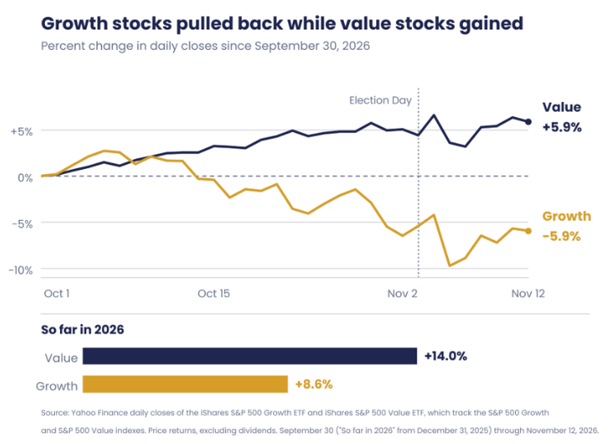
Since the end of September, two large parts of the stock market have moved in opposite directions. Growth stocks, which are fast-growing companies, have pulled back. Value stocks, which tend to be steadier businesses, have gained over the same stretch. NASDAQ investors would describe a very different fall than someone who owned the broad market.
A good part of the shift traces back to data centers, which became one of the bigger issues in this month’s elections. On November 3, voters in 41 districts voted against new development. Democrats also won governor’s races in Texas, Ohio and Georgia after campaigning on pausing new construction. Texas alone accounts for about a quarter of the data center capacity planned in the U.S. According to Goldman Sachs, chipmakers and other companies tied to the build-out fell sharply in the days after the vote.
Voters’ main concern comes down to everyday costs. A data center campus can use as much electricity as a small city, worrying residents that they will end up shouldering much of the costs via higher energy prices. Water use and tax breaks for developers add to the frustration. The issue also crosses party lines. Before the election, Texas’s Republican governor had already paused new permits until the electricity and water review finished.
Turning campaign positions into policy will take time. The new governors take office in January, and some of their plans need approval from state legislatures. It is still unclear how a pause would treat projects that already have permits or construction underway. Analysts who follow the industry mostly expect delays and negotiation rather than canceled projects. Meanwhile, the companies building data centers still can’t get enough computing power. The largest cloud providers recently reported their fastest growth in years, and together they hold about $1.7 trillion in signed contracts for work they have not yet delivered. What holds them back is power, permits, and buildings.
Think about what happens when a town limits new home construction. The families looking for homes don’t go away. Some buy in the next town over, some wait, and some pay more to live where they wanted. Demand for computing works much the same way. If building gets harder in a few states, some projects will move elsewhere, others will take longer, and the companies behind them will pay more for power and local agreements. That may stretch the build-out over more years, but it does little to change how much computing power businesses are asking for.
The split between growth and value shows why portfolios own both. The news that weighed on technology this fall had little to do with a drugmaker, an oil producer, or a grocery chain. When one part of the market stumbles, another often carries more of the load, and a diversified portfolio does not depend on any single group of stocks, or any single election, to make progress.
Elections can change where data centers get built, how quickly and on what terms. Statehouses will debate those questions well into next year. The demand behind the build-out was in place long before Election Day, which makes the vote more likely to change its pace than its direction.
Recent Comments