

The last 5-6 weeks have tested investors’ resolve. The geopolitical environment has leaked into the financial markets via reaction to the Middle East conflict. Risk temperaments can be tested when an inevitable market decline occurs.
In some ways, declines are not all that bad. Financial markets can get ahead of themselves, meaning that stock prices can be bid up beyond the supportive fundamentals. This occurs due to investor enthusiasm.
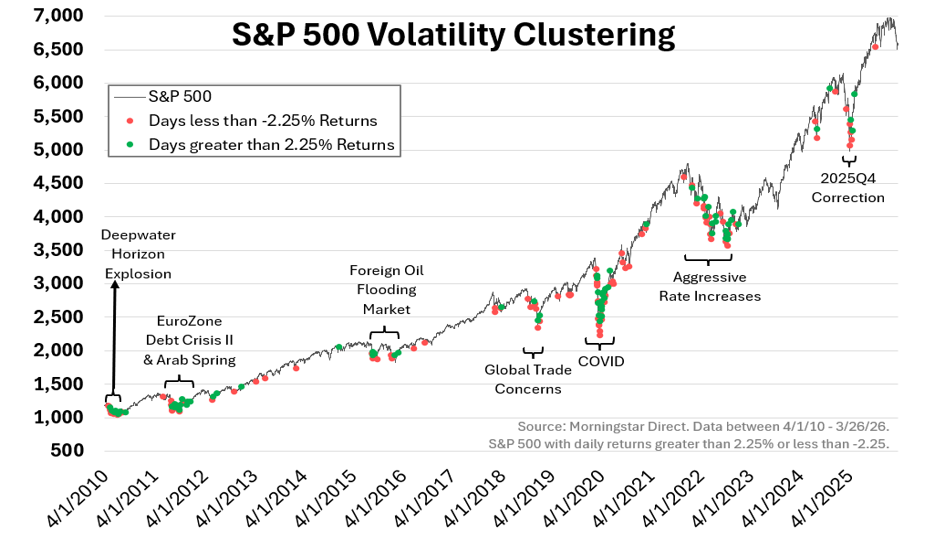
Just as markets move away from fundamentals on the upside, they can get carried away on the downside. There is an old adage, “markets [in the short term] are driven by fear and greed.” Upon reflection, these are emotional reactions, not rational deliberations. In the long term, financial markets are more rationally oriented.
Historical data demonstrates that major dramatic declines are often accompanied by major upward movements. Intense up-and-down movements tend to be clustered together. Jostling stock prices are simply a result of the stock market adjusting to an unforeseen shock. The market tends to overcorrect previous movements until it settles into a new equilibrium. Such periods can be scary, but they are a normal market response.
Our study of market statistics has revealed the consistency of normalized market oscillations. Such statistics play into the backdrop of our approach. Note, the statistical record is not gospel, but guidelines to develop a reasonable risk/reward framework for portfolio construction. Market corrections, defined as a market decline of 10% (similar to one we just went through), occur about once a year on average. Coincidentally, the last 10% decline occurred between mid-February 2025 and early April 2025, about a year ago.
Here’s the main point: investors who become too emotionally focused and succumb to their fears realize all the heat and earn none of the light. Volatility clustering suggests the light is around the corner. Keeping proper perspective during declines is an important investment tenet and helps ease the psychological angst.
Markets are always moving up, down, and sideways. While unsettling, market volatility is inevitable and completely normal. The challenge for investors is to not let market declines get them off track as they seek to achieve long-term goals. Time after time, stock markets have recovered from the disruptive short-term declines and gone on to post gains.
Recent Comments