

February shivers were followed by geopolitical jitters. Volatility picked up in February, culminating in an early March crescendo. Against a historical perspective, the recent volatility was barely above the average and well within the norm.
To those not engaged in the daily ebb and flow of financial markets, the Chicago Board Options Exchange’s (CBOE) Volatility Index (a.k.a. VIX) can be a vague indicator. At the end of the day, it measures the stock market’s volatility, or the
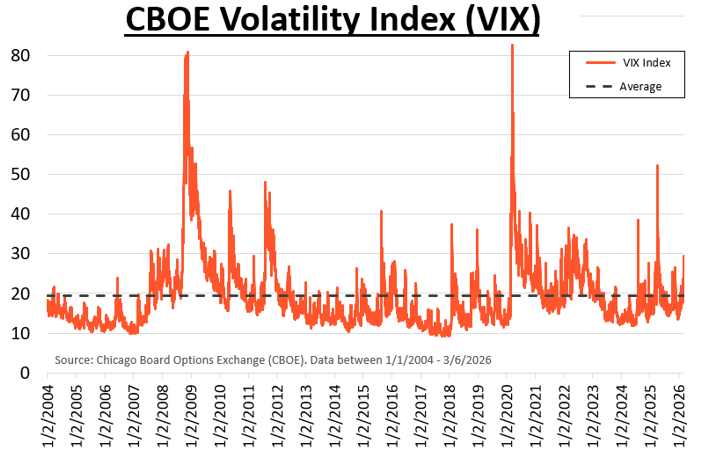
market’s oscillation. The VIX is often referred to as the “fear gauge.” Confident periods are typically accompanied by low VIX levels, while high points convey anxious investors.
February’s higher VIX levels caught many by surprise. This is partly due to recency bias. Our brains place higher importance on recent happenings as they are easier to recall, comprehend, and assimilate than historical data. This is referred to as recency bias. For nearly six months leading up to February, the low VIX recency bias conditioned investors to expect low volatility as the norm, juxtaposed to the actual backdrop. The volatility uptick was simply a return to normalcy, though it felt like exceptional unease.
Let’s take a step back for a broader perspective. Let us go back 22 years. (We could go back further, but there is little difference.) From this longer vantage point, the recent uptick in volatility does not seem so daunting. In other words, the recent volatility is routine and well within the norm.
What caused slightly higher volatility? In short, the market’s reaction to mostly non-economic news. Data released throughout late January into February centered around geopolitical and Supreme Court decisions, while March was highlighted by military attacks. For a few months, we’ve cautioned that higher stock valuations can lead to news sensitivity, resulting in volatility.
Oscillations come in daily, weekly, monthly, and annual movements. Mathematically, volatility levels spend time above and below the long-term average. After all, an average is just that. At extremes, volatility can be considered a contraindicator. Very high volatility will eventually calm. Calm volatility will give way to instability. Recognizing such ebb and flow as normal market activity can help mitigate one’s investing anxiety.
In the first couple months of 2026, equity markets have been range-bound while fixed income markets have claimed steady advances. Closer inspection echoes early 2025 with foreign stocks and smaller companies leading larger U.S. companies. The underlying economic fundamentals generally remain in good shape with solid Q4 earnings growth, including surprises across most industries. The recent volatility uptick may be caused by geopolitical events and valuation sensitivity, but it does not suggest economic derailment.
Recent Comments