

“New foreclosures jump 20% in October, a sign of more distress in the housing market” was the recent headline on CNBC1. Certainly, a headline meant to catch one’s eye to read the article. The current-day parlance is clickbait. Concerned that we might have missed or misinterpreted data, we clicked on the article. It turns out the article was a red herring.
The CNBC article tossed around figures with dizzying fervor.
Sometimes referring to monthly changes, other times mentioning annual or year-over-year changes. TO further confuse the reader, CNBC tossed around references to different foreclosure phases. Oddly, the article quoted real estate data experts, both of whom cited that the foreclosure data did not pose an alarm and is below historic norms. In other words, keep calm and carry on.
First, is there anything to worry about in the latest foreclosure data? At this point in time, the answer is no. Not only are foreclosures below historic norms, the forward picture looks pretty good. The Federal Reserve’s rate cuts should translate to falling mortgage rates, encouraging home purchases and refinancing. In fact, we expect the primary house selling season (spring and summer) to see accommodative interest rates. Also, home prices are falling, making housing more affordable. We will continue to monitor economic and market data for changes or deviations.
Second, if the data confirms there is nothing to worry about, how does CNBC get away with an alarming headline? The figures may be technically correct, but contextually wrong. The answer lies in relative versus absolute percentages. Disappointingly, data misrepresentation is not relegated to financial headlines.
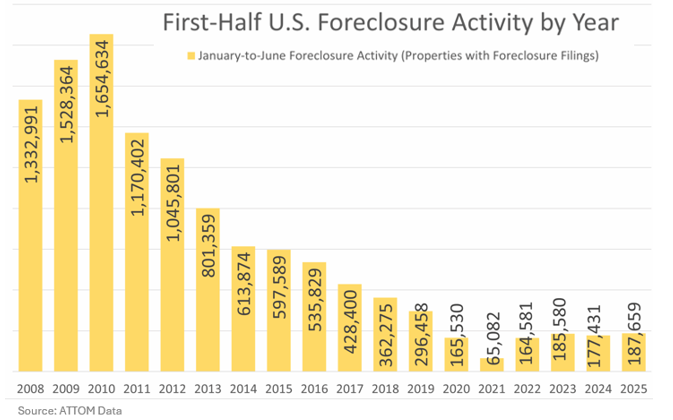
Reviewing foreclosures for the first half of the last 18 years exemplifies the issue. The chart displays foreclosures for the first half of each year. (Quarterly data is presented due to ease of data availability and to escape monthly oscillations.) No doubt, foreclosures in 2025 have risen to 187,659, or 10,288 over the same period of 2024. This is an increase of 5.8%. Sounds alarming. But, with a broader context, we can see that foreclosures are within range of the past few years. Additionally, considering there are more houses today than in the past, the 187,659 foreclosures are less impactful. Over the long term, foreclosures have been below average for the past 18 years. (Again, the data is for the first six months for all years.) Keep in mind, interest rates were extremely low between 2010 and 2019 (hence, eased finance servicing) while foreclosures were considerably higher than in 2025.
Did foreclosures go up? Yes. Is it material or an economic canary-in-the-coal-mine? No. Is the noted foreclosure change worthy of a major headline? Arguably not. A recent Gallup poll noted that trust in the media has been falling for decades and recently hit an all-time low.2 It seems clear that data misrepresentations have contributed to Gallup’s findings. Return to the Walter Cronkite era may help earn trust back.
“And that’s the way it is.” Wishing you a very Happy Thanksgiving!
Recent Comments