

The Times, They Are A-Changin’, a song written by Bob Dylan in 1964 during the 1960s civil rights movement, was an anthem of change. We might be so bold as to borrow it to describe the changing landscape of the financial evolution.
Until recently, the predominant investment vehicle has been mutual funds. Mutual funds date back to 1929. A mutual fund is a pooled investment product invested in a “pool” of stocks, bonds, or similar assets managed by a portfolio manager with a stated objective for
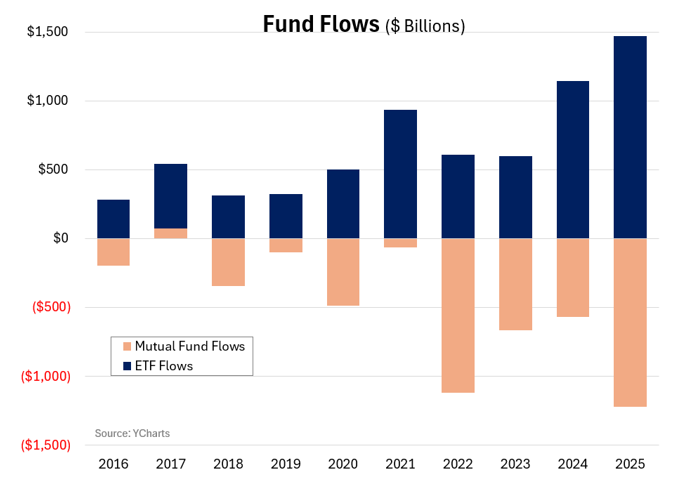
the benefit of the shareholders. Mutual funds were the vehicle of choice for their accessibility and reasonable costs. According to Morningstar, there is about $3.5 Trillion in mutual funds as of March 31st.
There’s a new kid on the block, and his name is ETF, for Exchange Traded Fund. ETFs have been around for decades primarily as a vehicle to invest in an index, like the S&P 500. Index investing is known as “passive” investing, as there is no portfolio manager taking an active role in the security selection process.
However, in 2019, the Securities Exchange Commission (SEC) changed the rules that streamlined the ETF rules and processes. Many investment companies quickly began supplementing their passive ETF offering with “active” ETFs. Actively managed investment strategies (whether a mutual fund or an ETF) can adapt to changing market environments in pursuit of more attractive risk-adjusted returns. In the last few years, investors have been directing more of their investment dollars towards ETF vehicles.
In many ways, active ETFs operate in much the same way as an actively managed mutual fund. Investors can invest in a diverse pool of securities that is managed professionally on behalf of all shareholders according to a stated objective or investment strategy. Both active ETFs and active mutual funds allow individual investors to benefit from the expertise offered by professional management through an active strategy that typically seeks to outperform the target benchmark index. The structural similarities are accompanied by differences.
Though it can be difficult to differentiate between a fad and a bona fide change, ETFs are here to stay. As the investment landscape evolves, we have been proactive in staying with the times. Many client portfolios have gained exposure to ETFs over the years. As we
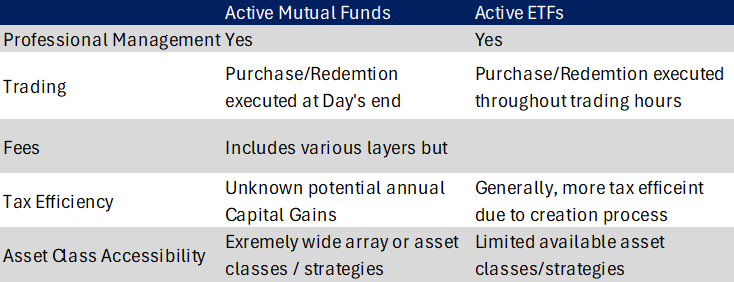
analyze money managers, investment vehicles, and portfolio structures, we will remain diligent about innovative vehicles. Fund implementation (be it mutual funds or ETFs) depends on money managers’ measured achievement as well as the goals and structural suitability of client objectives. As more active ETFs are made available, we are evaluating more of these choices, which could result in a larger representation in client portfolios.
Recent Comments