

One of the most overlooked components of portfolio construction is Asset Location. While Asset Allocation determines the mix of stocks, bonds, and other investments, Asset Location focuses on what types of accounts those assets are held within. Implementing an effective Asset Location strategy can materially improve after-tax returns without changing the underlying risk of your total portfolio.
The core principle of asset location is tax efficiency. Different asset classes generate different types of income, each taxed at varying rates. For example, interest income from taxable bonds is generally taxed at ordinary income rates, which are typically higher than long-term capital gains rates. As a result, placing tax-inefficient assets (such as taxable bonds or actively managed funds with high turnover) into tax-advantaged accounts can help shield that income from immediate taxation.
Conversely, tax-efficient assets are better suited for taxable accounts. Equity index funds and ETFs, which tend to generate relatively low turnover, and actively managed ETFs, which can limit capital gain distributions, are ideal candidates. In addition, Municipal bond interest is free from federal income taxes, and potentially from state income taxes. These investments benefit from preferential tax treatment and allow investors to defer taxes until gains are realized, enhancing compounding over time.
Roth accounts offer a unique advantage of tax-exempt qualified withdrawals. This characteristic makes Roth accounts the best location for assets with the highest expected
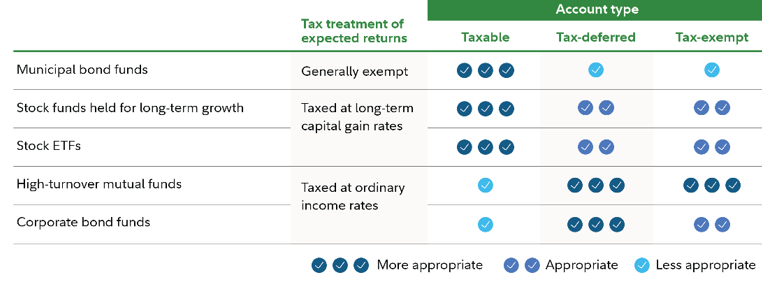
growth and turnover potential, such as small-cap equities or emerging market investments.
Tax-deferred accounts (Traditional IRAs and 401(k)s) fall somewhere in the middle. Contributions are typically tax-deductible, and taxes are deferred until withdrawal, at which point distributions are taxed as ordinary income. These accounts are well-suited for income-generating assets, such as corporate bonds, where the tax deferral can offset the otherwise higher tax burden.
It’s also important to consider rebalancing and withdrawal strategies. Asset Location decisions should align with how and when funds will be accessed. For instance, retirees may benefit from drawing down taxable accounts first to allow tax-advantaged accounts to continue compounding. A byproduct of such withdrawal considerations is separating risk into different accounts. Additionally, rebalancing across accounts, rather than within a single account, can minimize unnecessary taxable events.
In practice, Asset Location is not a one-time decision, but an ongoing process that should adapt to changes in tax law, market conditions, and an investor’s financial situation. Being wealth managers, as opposed to money managers, we take a multi-disciplined, holistic view of all your investments and their placement to maximize your gains.
Recent Comments