

Perception versus reality. When asked how optimistic or pessimistic one feels about their finances, individuals have been answering that question with an increasingly dour response. The Index of Consumer Sentiment has been trending down for the past 2 ½ years, so much so that the most recent reading is the lowest on record. For a measure that’s been around since 1952, that’s saying a lot.
Iconically, Retail Sales, a measure of consumer spending, has been trending higher over the same period. Retail Sales are an objective proxy to see actual dollars spent on personal and household use. Even after inflation adjustments, Retail Sales have shown that despite consumers’ pessimistic tone, they are still freely spending money on items they need and enjoy.
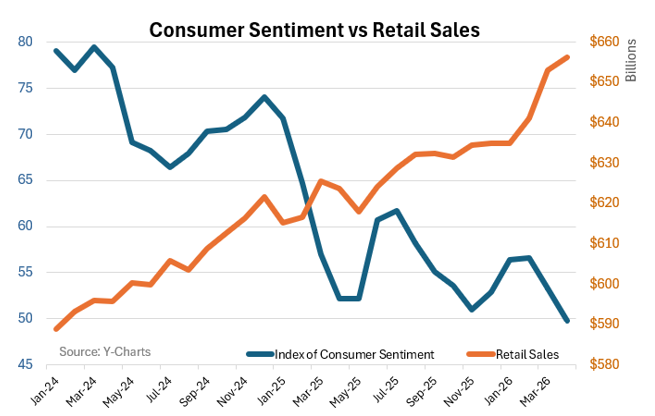
This creates quite a quandary. How are people the most pessimistic ever (including the ‘70s Oil Embargo, 73/74 Recession, the early ‘80s Double Dip Recessions, the early 2000s Tech Wreck, 2008-09 Global Credit Crisis (GCC), and the 2022 Federal Reserve aggressive rate hikes), yet continue to spend money at levels never seen before? Why aren’t consumers (in the aggregate) pulling back on their spending if their outlooks are so depressed? We wish we had answers to this perplexing dilemma. But we do have a few observations that may shine light on takeaways. Note, lower sentiment transcends the recent Iran conflict, so that’s not the culprit.
First, Retail Sales have been very consistent with their upward trend. Since 1992 (Retail Sales inception), Retail Sales have only meaningfully dropped twice; during the 2008-09 Global Credit Crisis and during COVID. The Global Credit Crisis was a multi-year economic incident second only to the Great Depression. So, this makes sense. (By the way, Retail Sales took four years to return to pre-GCC highs.) The drop off during COVID occurred as the U.S. and other countries artificially shut down economic transactions due to the pandemic. Beyond these two periods, Retail Sales normally tend to be higher.
On the other hand, sentiment is more of a psychological survey. How do you feel today? The monthly Consumer Sentiment survey may have caught you in a bad mood after a poor night’s sleep, an argument with your spouse, or a recent fender-bender. Further, news outlets have learned that sensationalized negativity sells advertisements. There is a reason the news business can be summarized by the well-known cliché “what bleeds leads.” With the 24/7 news cycle, we are constantly bombarded with negatively biased news.
More recently, news outlets have noted the falling Consumer Sentiment numbers, suggesting it to be a canary in the coal mine. The reality is there is little evidence of a causal economic relationship. Consumer Sentiment is more of an interesting data point, but with little bite. Think of that little barking Chihuahua, all bark with no bite.
Recent Comments