

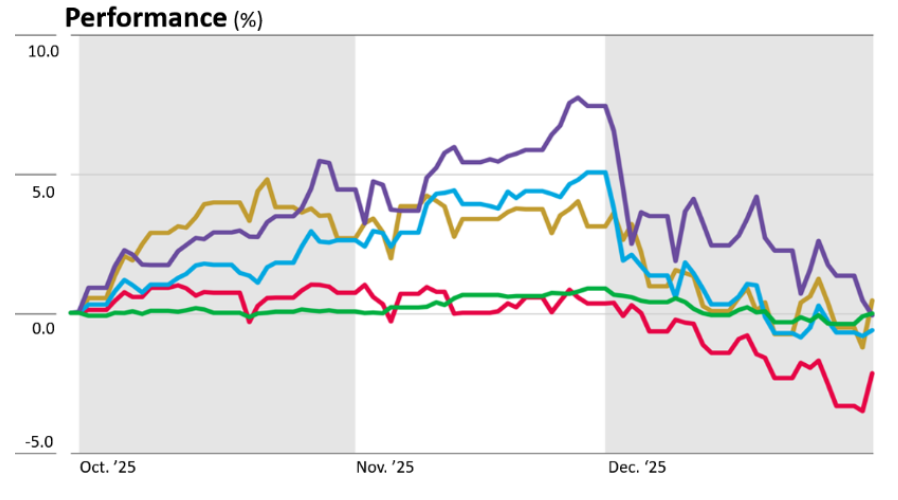
The first quarter of 2026 was a good reminder that financial markets do not move in a straight line. After posting very strong returns in 2025, equity and bond markets experienced notable volatility to start 2026. The recent Iran events give us reason to create a singular cause and effect, yet the first quarter had a repertoire of volatility–inducing headlines.
The Supreme Court ruled that tariffs imposed under the International Emergency Economic Powers Act (IEEPA) were illegal, removing the legal basis for more than half of the duties collected since early 2025. The administration has already begun using alternative tools to reimpose tariffs in roughly the same shape and form as they existed prior to the ruling.
Software companies were in focus due to AI-driven disruption and potential spillovers for private credit. Software equities sold off sharply in Q1, reflecting growing concerns that AI-driven disruption could pressure earnings and undermine business models across the sector. Software exhibits high leverage and the lowest interest coverage, making it a focus of concern for private credit lenders.
In early March, the President officially nominated Kevin Warsh for Federal Reserve (Fed) Chair. Some senators signaled they may delay any Fed confirmation until the investigation into the Fed’s spending is fully resolved, leaving Powell as Chairman or the position goes vacant. Opaque Fed leadership during a potentially pertinent interest rate period caused some nervousness within the markets.

Middle East tensions kept oil markets on edge in Q1 and remained the most important risk. Middle East tensions were a major driver of volatility in Q1, as the escalating conflict disrupted energy infrastructure and shipping flows, most notably through the critical Strait of Hormuz. Geopolitics remain an important risk to monitor heading into Q2, as each new headline can quickly shift expectations around supply risks, shipping disruptions, and the conflict’s duration.
Yet, the fundamentals remain positive. Recent economic data suggest the economy is making slow and steady progress. Inflation and employment did not reach feared extremes but still have room for improvement. AI and data centers investments are accelerating. Rising equity valuations and home prices have lifted household net worth, supporting consumer confidence and spending. Absent a prolonged Iran conflict (admittedly a big “if’), the underlying trend in energy markets favors lower prices, acting as a de facto tax cut for consumers. Lastly, aggressive tax incentives, depreciation, and credits encourage business and consumer spending.
EQUITY MARKETS
After several strong quarters in a row, equity markets pulled back across the board. The bulk of the quarter’s losses occurred following the start of the Middle East war. From mid-quarter peaks, U.S. equities declined 5%, while international and emerging market equities fell 10% and 13%, respectively. Beneath the headlines, market leadership shifted. Small- and mid-cap equities outperformed large-caps, a reversal of last year’s trend. Value stocks closed the quarter higher relative to growth stocks. In contrast to the last couple of years, the “Magnificent 7” stocks detracted from the broader market. Yet, from a historical perspective, the U.S. stock market remained concentrated with a large weighting to a handful of companies. Energy markets took the lead due to the Iran war, while technology and precious metals gave back some gains.
Overseas, emerging markets initially continued to outperform developed markets, led by AI-exposed markets such as Korea and Taiwan. The Emerging Markets index faded from up 15.4% in late February to end at -0.2%. The developed international Europe, Australia, and Far East (EAFE) index finished the quarter -1.25%.

FIXED INCOME MARKETS
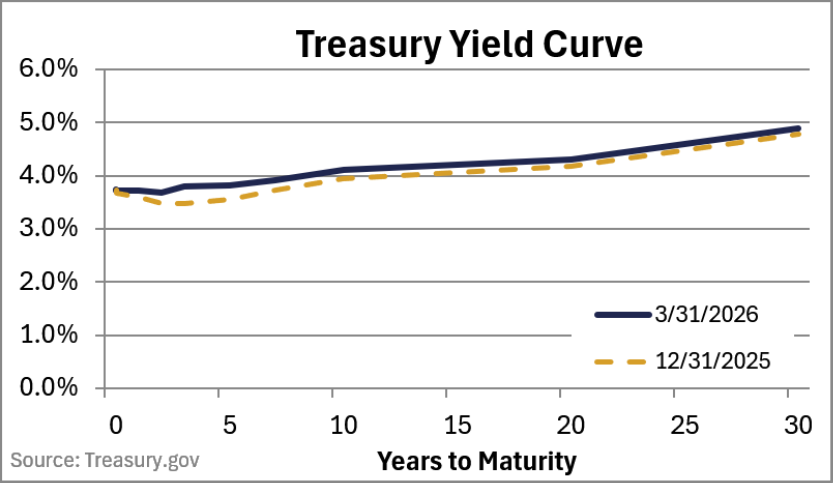
Bonds would normally be a safe-haven trade during global disruptions. However, U.S. Treasury yields have risen in anticipation of worsening inflation related to energy price shocks. The U.S. Treasury yield curve has maintained an upward slope, signaling economic growth in the quarters ahead, but it also has shifted a bit with nuanced implications for the economy and interest rates. Bond returns for the quarter were mostly flat as the upward shift in yields counteracted the bonds’ coupon income.
CONCLUSION
Though volatility can be scary, normal volatility like this is just the price of admission for portfolio growth over the longer term. Market corrections occur more frequently than most realize. The last bout of similar volatility occurred almost a year ago. Portfolio construction techniques attempt to mitigate extreme volatility but can’t rid all volatility. Succumbing to conservation impulses often leads to punishing one’s long-term goals. Maintaining a well-diversified portfolio remains the best way to achieve financial goals.
www.heritageconsultants.com
The opinions expressed are those of Heritage Financial Consultants, LLC and not necessarily those of Osaic Wealth, Inc. Forward looking statements may be subject to certain risks and uncertainties. Actual results, performance, or achievements may differ materially from those expressed or implied. S&P 500 index measures the performance of 500 stocks generally considered representative of the overall market. Russell 2000 measures the performance of US small cap stocks. MSCI EAFE measures the performance of large and mid-caps of developed markets excluding the US and Canada. MSCI EM measures the performance of the large and mid-caps of emerging market equity securities. Bloomberg US Aggregate Bond index measures the performance of US investment grade bonds, including Treasuries, government agencies, corporates, MBS and ABS. Securities and investment advisory services offered through Osaic Wealth, Inc., member FINRA/SIPC. Osaic Wealth is separately owned and other entities and/or marketing names, products or services referenced here are independent of Osaic Wealth.
Recent Comments