
Ask someone who bought a house in 2021 whether they plan to move. You will usually get the same answer: not at these rates. Their loan is fixed somewhere near 3%. A new one runs closer to 6.7%. Same house either way, nowhere near the same payment, and that gap is doing more to shape the economy than anything happening in the bond market.
Mortgage debt gets talked about far less than government debt, which is understandable: the government’s number is the bigger one. The interest on it has already cost $931 billion in the first ten months of this fiscal year, about 10% more than the same stretch last year, and is on track to take the biggest bite out of the economy on record. That is a real problem, but a slow one. What it will not do is change what anyone pays next month. The two get discussed as one conversation, but they are not.
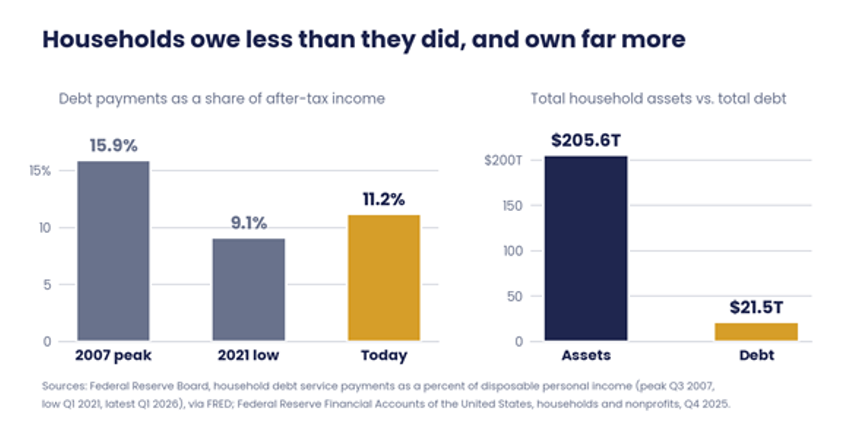
Who actually owes money at today’s rates? Fewer people than the headlines suggest. Debt payments take 11.2% of after-tax income. In 2007 it was nearly 16%. Three years of higher rates barely moved it, for a simple reason: a fixed mortgage does not care what rates did after you signed it. Higher rates only reach the next borrower.
The other side of the ledger rarely comes up. Households owned about $205 trillion in assets at the end of last year, against $21.5 trillion of debt. Close to ten dollars owned for every dollar owed. Even measured against the $40 trillion the federal government owes, household assets are five times larger. The government’s balance sheet is a big number sitting inside a much bigger one.
Averages do hide people. Roughly one dollar in twenty of household debt is past due, and the new trouble is turning up in credit cards and car loans: the borrowing that reprices immediately, and that people lean on when something else gets tight.
Which brings it back to the front door. The same fixed mortgage that protects the household ledger is what keeps people in place. Existing homes are selling at about 4.06 million a year, flat with last summer, at a median price near $434,100 that is still drifting up. This is a market where fewer people are willing to trade places, because of rates rather than distress.
Turnover deserves more attention than prices, because so much rides along with it. Nobody hires a mover, repaints a hallway, or buys a refrigerator because prices went up 2%. They do it because they moved. That is how a housing slowdown reaches the economy without showing up much in home values. The encouraging part: inventory is the loosest in years, and that is the piece time tends to fix.
So the two debts in this story are moving in opposite directions. The government’s keeps growing. What households owe takes a smaller share of their income than it did before the last housing bust, mostly because so much of it was locked in at rates that are not coming back soon. Higher rates have not strained the family balance sheet, but they have made the family reluctant to move, and it is the missing moves the economy feels. Where mortgage rates settle from here is not something we would predict. Either way, this is a more fixable problem than a debt crisis.
Recent Comments