

Resilient is the best way to summarize the second quarter. As the second quarter progressed, the financial markets looked past the Iran conflict as early irritants subsided. Elevated oil prices tumbled in the closing weeks as the Strait of Hormuz reopened. Oil prices neared the pre-Iran conflict prices in the quarter’s final days. With fossil fuels being an economic fundamental, we should see accretive inflation benefits going forward.
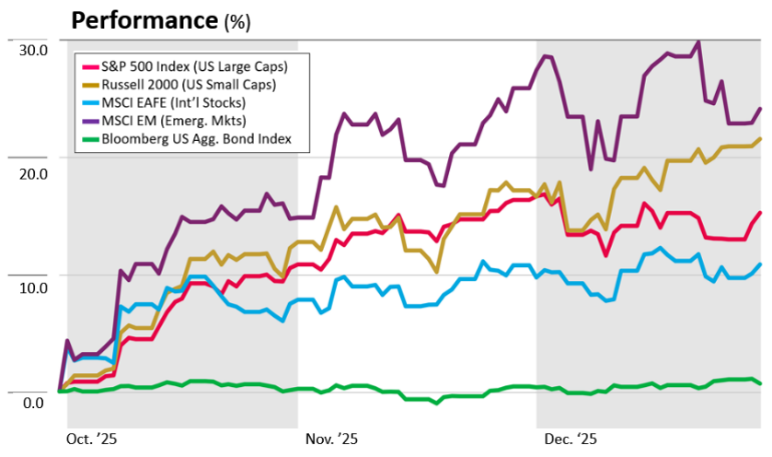
Economic growth remained positive. The composition of growth has become more important as businesses focused on tax and fiscal stimulus and ancillary AI development, such as data center real estate and supportive functions including dependable energy sources and HVAC/cooling. First-quarter Gross Domestic Product (GDP) growth was revised higher to a 2.1% annualized rate, up from the revised 1.6%. Investors continue to favor companies with visible earnings power, pricing flexibility, and strong financial positioning. April’s rally suggested financial markets were willing to look through some macro uncertainty. As the quarter progressed, markets discounted any lasting impact from the swirling geopolitical events.
Consumers in aggregate, who make up about 2/3 of the economy, remained resilient throughout the quarter. US retail sales numbers are firmer than anticipated, quelling concerns of a weakening consumer. The University of Michigan Consumer Sentiment Index bounced off its record lows, likely reflecting some relief in lower gas prices. In a rare reading, consumers began pricing in improved future expectations from their current conditions.
Strong business investment and sentiment indicated business resilience. Businesses digested the Iran conflict as they have with most historical geopolitical entanglements, as a near-term headache rather than a long-term redirection. Corporate earnings from the first quarter (reported in the second quarter) showed resilience, with positive forward guidance as icing on the cake.
The newly appointed Federal Reserve (Fed) Chairman, Kevin Warsh, met his first challenge by leaving rates unchanged. Warsh departed from previous Fed chairpersons by offering forward-looking comments. Warsh prefers to let the financial markets interpret incoming information rather than to guess how the Fed will react to it: a slight distinction, but a meaningful difference.
The geopolitical situation and public comments surrounding it were the primary drivers of the market’s ups and downs. However, by the end of the quarter, the geopolitical situation was mostly an afterthought in light of the resilient economy.
INFLATION
Inflation remained one of the most important market variables through the second quarter. Headline Inflation accelerated in the second quarter due to higher energy costs associated with the closure of the Strait of Hormuz. Core Inflation (inflation excluding volatile food and energy components) showed modest gains, suggesting that energy inflation has not yet significantly affected other areas. The quarter closed with plummeting energy prices, which was a result of the reopening of the Strait of Hormuz. Falling energy prices should culminate in lower inflation, should the Strait remain open. Still, the Fed remains on guard as inflation remains above their 2% target.

EQUITY MARKETS
Stocks staged a comeback in the second quarter of 2026, making for their best quarter since the spring of 2020. Investors looked past the dislocations from the Iran war and growing expectations of Federal Reserve interest rate hikes. The rally was led by risk-on assets and a revival of the AI trade, with a different set of players than before, as hardware (microchips and robotics) stocks posted massive gains. Notably, even after three years of big gains in the AI trade, the quarter saw some of the biggest quarterly rallies on record for some AI-heavy indexes.
Markets broadened out as earnings continue to drive equity markets. Robust first-quarter earnings helped equity markets offset geopolitical concerns. Forward guidance, though tempered, suggested future earnings growth via AI productivity gains. Consumer spending trends will also play a significant role in realizing earnings estimates, and recent job reports suggest positive momentum or, at minimum, stability.
FIXED INCOME MARKETS
After a turbulent first quarter marked by the onset of the Iran war, the bond market found some footing in 2026’s second quarter. The Bloomberg U.S. Aggregate Bond Index, a proxy for the US investment-grade bond market, eked out a 0.7% gain in what proved to be another challenging quarter for fixed-income investors.
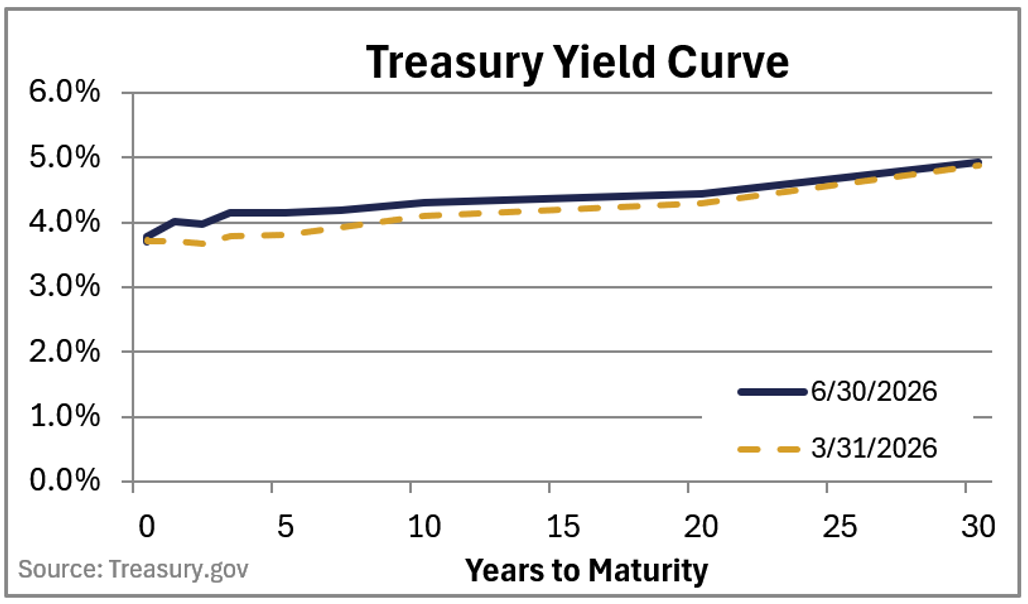
Persistent interest rate volatility and inflation concerns refocused market expectations from pricing in multiple interest rate cuts by the end of 2026 to pricing in the probability of tightening rate hikes by year-end. Treasury yields increased, with the short end of the curve increasing more than the long end, causing the yield curve to flatten. Meanwhile, continued economic stability and strong corporate fundamentals gave corporate bonds reason to remain closely priced to lower-risk US Treasuries.
CONCLUSION
The second quarter showed that the market’s upward trend remains intact, but the path has become more selective. AI and technology still matter, but investors are less willing to chase the theme without evidence of continued earnings strength. Broader participation from small caps and cyclical areas is a positive sign. If inflation remains sticky, however, policy expectations could become less supportive, and volatility could return quickly. Maintaining a well-diversified portfolio remains the best way to achieve financial goals.
The opinions expressed are those of Heritage Financial Consultants, LLC and not necessarily those of Osaic Wealth, Inc. Forward looking statements may be subject to certain risks and uncertainties. Actual results, performance, or achievements may differ materially from those expressed or implied. S&P 500 index measures the performance of 500 stocks generally considered representative of the overall market. Russell 2000 measures the performance of US small cap stocks. MSCI EAFE measures the performance of large and mid-caps of developed markets excluding the US and Canada. MSCI EM measures the performance of the large and mid-caps of emerging market equity securities. Bloomberg US Aggregate Bond index measures the performance of US investment grade bonds, including Treasuries, government agencies, corporates, MBS and ABS. Securities and investment advisory services offered through Osaic Wealth, Inc., member FINRA/SIPC. Osaic Wealth is separately owned and other entities and/or marketing names, products or services referenced here are independent of Osaic Wealth.
Recent Comments